Major AI Companies Are Cutting Off Access to Frontier Models
Anthropic and OpenAI are limiting their most powerful models to select partners. What this means for heavy AI users paying $300+ monthly.

A seismic shift is happening in the AI industry that could fundamentally change how heavy AI users access the most powerful models. Major AI companies like Anthropic and OpenAI are moving away from open access to their frontier models, instead limiting them to select partners and enterprises. For TokenKarma users who spend $300+ monthly on AI tools, this represents a critical inflection point.
The New Reality of Restricted Access
The writing was on the wall when Anthropic announced its Mythos cybersecurity model in April 2026, making it available only to a select few companies. What initially seemed like an isolated security measure has now become a broader trend. OpenAI followed suit with their Daybreak initiative, confirming that their most advanced models would also see restricted rollouts.
According to a detailed analysis by AI policy researcher Anton Leicht, this marks the end of what he calls the “Andy Warhol era of AI access” - where rich and poor users had access to the same AI capabilities through simple API calls.
The implications are stark: frontier AI access is becoming a privilege, not a right.
Why Companies Are Restricting Access
The shift toward restricted access is driven by three key factors that directly impact heavy AI users:
Security Concerns
Advanced AI models like Mythos can identify and exploit cybersecurity vulnerabilities at an unprecedented scale. Companies are genuinely concerned about these capabilities falling into the wrong hands. As Leicht notes in his analysis, “firms actually felt vulnerable to the exploits it could find.”
For TokenKarma users, this means the most powerful AI tools for security analysis, vulnerability testing, and defensive cybersecurity may only be available through approved enterprise channels.
Economic Constraints
Training and running frontier models costs hundreds of millions of dollars. As compute becomes scarce and expensive, companies are prioritizing access for customers who can pay premium rates or provide strategic value.
Heavy AI users who currently enjoy unlimited API access may soon find themselves competing for compute resources with deep-pocketed enterprises and government agencies.
Government Intervention
Perhaps most concerning for individual heavy users, government agencies are increasingly involved in determining who gets access to frontier AI capabilities. The article reveals that models may first go to U.S. national security apparatus before being released to select private companies.
This creates a hierarchy where access depends not just on your ability to pay, but on your relationship with approved partners and compliance with government security requirements.
The New Access Hierarchy
Under the emerging model, frontier AI access will likely follow this pattern:
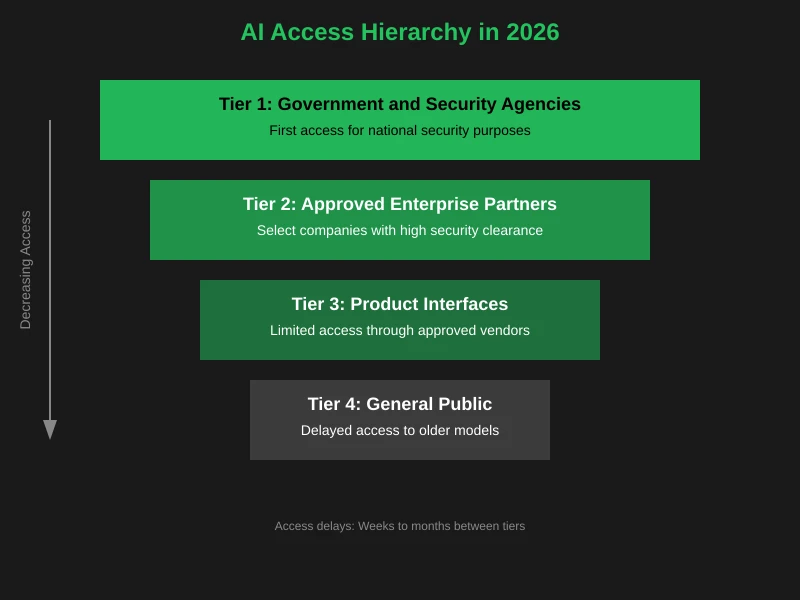
- Tier 1: Government and Security Agencies - First access for national security purposes
- Tier 2: Approved Enterprise Partners - Select companies with high security clearance and KYC compliance
- Tier 3: Filtered Product Interfaces - Limited access through approved vendors and product wrappers
- Tier 4: General Public - Potentially months-delayed access to older model generations
For most TokenKarma users, this means moving from direct API access to working through intermediary platforms that may add cost, reduce functionality, or limit usage quotas.
What This Means for Heavy AI Users
If you’re spending $300+ monthly on AI tools, here’s how these changes could impact your workflows:
Higher Costs
Premium access to frontier models will likely come with premium pricing. Enterprise partnerships and compliance requirements add overhead costs that get passed to users.
Limited Flexibility
Instead of direct API access, you may need to work through approved platforms that limit how you can use the models. Custom fine-tuning, specific prompt engineering techniques, or bulk processing may become restricted.
Delayed Access
New model capabilities may take months to reach general availability. If your competitive advantage depends on accessing the latest AI capabilities, you could find yourself at a disadvantage.
Vendor Lock-in
With fewer options for accessing frontier models, you may become dependent on specific enterprise platforms or approved vendors, reducing your negotiating power and increasing switching costs.
Preparing for the New AI Economy
Heavy AI users should consider several strategies to maintain access to cutting-edge capabilities:
Build Enterprise Relationships
Start establishing relationships with approved enterprise AI platforms now. Companies like Microsoft, Google Cloud, and AWS are likely to secure preferential access to frontier models through their enterprise partnerships.
Diversify Your AI Stack
Don’t rely on a single provider. Develop workflows that can work across multiple AI platforms and model providers to maintain resilience when access restrictions change.
Consider Open Source Alternatives
While open source models currently lag behind frontier proprietary models, this gap is narrowing. Invest in capabilities to run and fine-tune open source models as a hedge against restricted access.
Evaluate Compliance Requirements
Understanding and meeting enterprise security and compliance standards may become necessary for maintaining access to the most powerful AI tools.
The Broader Implications
This shift represents more than just a business model change. It signals the maturation of AI from a democratized technology to a strategic resource controlled by a small number of actors.
As Leicht warns in his analysis, “countries will be divided into the frontier haves and have-nots” with those having access potentially becoming “much wealthier and safer than the latter.”
For heavy AI users, this means the competitive advantages from AI access may become more pronounced and longer-lasting. Those who secure privileged access early may maintain significant advantages over competitors who don’t.
Looking Ahead
The transition to restricted AI access won’t happen overnight, but the trend is clear. Heavy AI users need to start planning now for a future where access to the most powerful AI capabilities is no longer guaranteed through simple API calls.
The companies that adapt quickly to this new reality - by building enterprise relationships, diversifying their AI stack, and meeting compliance requirements - will be best positioned to maintain their AI competitive advantages.
For the rest, the future may look a lot like the present, but with older models and higher barriers to accessing the cutting edge.
The AI revolution is entering a new phase. The question for heavy users is: will you be on the right side of the access divide?
Now available
Stop guessing your AI limits
The Mac app and web dashboard watch your Claude, ChatGPT, Gemini and more, and warn you before quotas hit.